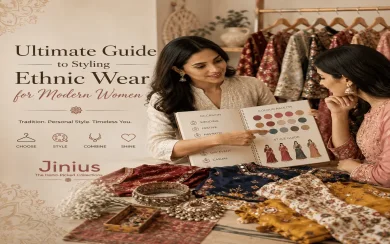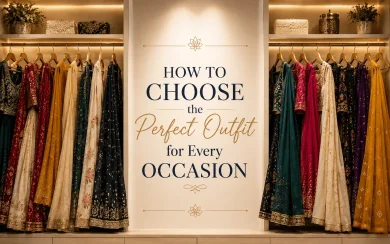

Ethnic wear has always been an essential part of every woman’s wardrobe. From traditional sarees to trendy lehengas, ethnic outfits reflect culture, elegance, and beauty. Today, modern fashion allows you to style ethnic wear in unique and stylish ways.
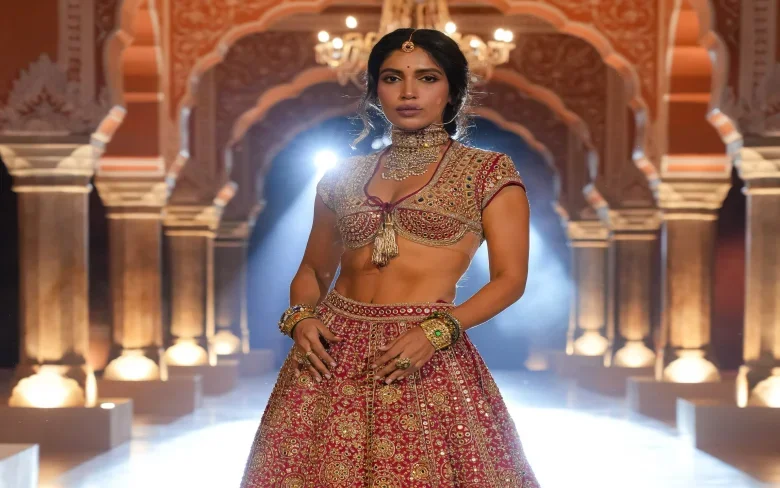
Top 10 Women’s Fashion Trends You Must Try in 2026
Indian fashion is having a global moment. From statement blouses and mirror-work Chaniya Cholis to dramatic dupattas and modern fusion silhouettes, traditional Indian craftsmanship is no longer limited to festivals or weddings. It is increasingly being interpreted as contemporary luxury fashion.
Indian clothing has always been admired for its rich colours, intricate handwork, graceful drapes and cultural storytelling. Today, pieces such as sarees, lehenga Cholis, Chaniya Cholis, handcrafted blouses and dupattas are finding their way into international fashion conversations, editorials, red-carpet styling and runway collections.
For a brand like Jinius – The Hand-Picked Collections, this evolution is particularly exciting. The philosophy behind Jinius is simple: carefully select fabrics, colours, threads, embellishments and combinations that allow traditional craftsmanship to feel relevant to the modern woman.
So, what should you be wearing in 2026?
Here is our guide to 10 women's fashion trends worth trying in 2026, along with practical ideas for combining colours, Chaniya Cholis, blouses and dupattas for different occasions.
📝 Introduction: Tradition Meets the Modern Wardrobe
Fashion in 2026 is not necessarily about choosing between traditional and modern clothing. It is about combining the two intelligently.
A handcrafted blouse can become the hero piece of an otherwise minimal outfit. A traditional dupatta can transform a simple dress. A colourful Chaniya can be paired with a more understated blouse. Even a heavily embellished piece can be styled in a way that feels elegant rather than overwhelming.
This is where the idea of mix-and-match ethnic fashion becomes powerful.
At Jinius, the focus is on creating combinations that allow women to express their personalities rather than simply following a predetermined outfit formula. Traditional pieces such as Chaniya Cholis, dupattas and blouses can be treated as individual styling elements, giving you multiple ways to build an outfit.
🌸 1. Statement Chaniya Cholis Are Back in the Spotlight
The Chaniya Choli is one of India's most recognisable festive silhouettes, particularly associated with Gujarat and Navratri.
Traditionally consisting of a flared Chaniya, fitted Choli and Dupatta, the outfit has evolved considerably. Today, the silhouette can range from colourful mirror-work designs to minimal contemporary versions.
The global fashion world has also embraced the dramatic proportions of the Indian lehenga and Chaniya Choli. Designers such as Rahul Mishra have presented elaborate, structured and embroidered Chaniya Choli-inspired silhouettes at international fashion events.
How to style it in 2026
Instead of matching every component perfectly, try creating controlled contrast.
For example:
- Bright Chaniya + solid-colour blouse
- Embellished Choli + relatively simple Chaniya
- Printed Chaniya + embroidered blouse
- Plain Chaniya + statement mirror-work blouse
- Multicoloured Chaniya + one-colour dupatta
Jinius colour formula
If your Chaniya already contains several colours, choose one colour from the embroidery and repeat it in the blouse or dupatta.
This creates coordination without making the outfit look overly matched.
Example:
A coffee-brown Chaniya with colourful mirror or floral embroidery can be paired with a deep green, rust, mustard or black blouse depending on the dominant embroidery colour.
✨ 2. Statement Blouses Become the Hero of the Outfit
The blouse is no longer simply something worn underneath a saree.
It can be the main fashion statement.
Intricate craftsmanship such as mirror work, embroidery, Zardozi and Chikankari has helped transform traditional Indian blouses into highly visible fashion pieces. Contemporary designers are also experimenting with corset-inspired silhouettes, asymmetric designs, structured sleeves and dramatic necklines.
This makes the blouse one of the most versatile pieces in your wardrobe.
Try these combinations
For a wedding:
Heavy embroidered blouse + plain or lightly detailed saree/Chaniya.
For Navratri:
Mirror-work blouse + colourful Chaniya + contrasting dupatta.
For Diwali:
Statement blouse + silk or elegant skirt + minimal dupatta.
For a fusion look:
Handcrafted blouse + high-waisted trousers or a contemporary skirt.
The idea of wearing a traditional blouse separately is already visible in global styling, where embroidered blouses are paired with trousers, skirts and blazers.
🪞 3. Mirror Work Continues to Define Indian Craft Luxury
Mirror work has a special place in Indian fashion, particularly in Gujarati and Rajasthani-inspired clothing.
Small reflective mirrors catch movement and light, making them particularly beautiful for celebrations and evening occasions.
The global appreciation of Indian craftsmanship is not new. Dior's Mumbai show incorporated Kutch mirror work, block printing and bullion embroidery, demonstrating how Indian artisan techniques can translate into international luxury fashion.
How to wear mirror work without overdoing it
The secret is balance.
If your blouse is heavily covered in mirrors:
Choose:
A simpler Chaniya + understated jewellery.
If your Chaniya has elaborate mirror work:
Choose:
A cleaner blouse + a dupatta that picks up one or two colours.
If both Chaniya and blouse are heavily embellished:
Keep the dupatta lighter and let the craftsmanship speak for itself.
🎨 4. Colour Blocking Is Replacing Perfect Matching
One of the easiest ways to make traditional clothing look modern is to stop trying to make every piece exactly the same colour.
Instead, think in terms of a colour family.
Try the 60–30–10 rule
A simple way to build a balanced ethnic outfit is:
- 60% — Base colour: Your Chaniya, saree or main garment
- 30% — Secondary colour: Blouse or dupatta
- 10% — Accent colour: Embroidery, jewellery, accessories or footwear
Some combinations to try
| Base Colour | Blouse | Dupatta / Accent |
|---|---|---|
| Coffee Brown | Rust / Mustard | Green or Pink |
| Purple | Emerald Green | Yellow or Pink |
| Rust Orange | Deep Green | Pink / Blue |
| Grey | Magenta / Green | Yellow |
| Black | Red / Green | Mirror Silver |
| Cream | Wine / Emerald | Gold |
| Navy Blue | Mustard | Pink |
| Maroon | Bottle Green | Gold |
The beauty of hand-crafted clothing is that small details in the embroidery can become your colour inspiration.
Instead of asking, “What colour matches this?”, ask:
“Which colour already exists in this garment that I can bring forward?”
💫 5. The Dupatta Is Becoming a Styling Statement
The dupatta deserves much more attention than it usually receives.
Traditionally used as the finishing element of an Indian outfit, the dupatta is increasingly being styled as an independent fashion accessory.
International styling has explored dupattas as dramatic capes, shoulder drapes, wraps and statement layers.
5 ways to style a dupatta
1. Classic shoulder drape
Perfect for weddings and family celebrations.
2. One-shoulder drape
Creates a cleaner, contemporary silhouette.
3. Waist-belted drape
Adds structure to a flowing outfit.
4. Cape-inspired drape
Ideal for an evening event.
5. Minimal single-side drape
Perfect when your Chaniya or blouse already has heavy detailing.
Jinius styling tip
If your Chaniya and blouse are colourful, consider a solid or subtly detailed dupatta.
If your Chaniya is relatively simple, use the dupatta as the statement piece.
🌿 6. Handcrafted Textures Are Becoming More Important Than Loud Prints
In an increasingly digital fashion world, consumers are becoming more interested in pieces that look and feel handmade.
Embroidery, mirrors, threadwork, borders, tassels and carefully placed embellishments give traditional garments a sense of individuality.
This is particularly relevant to Jinius, where the philosophy centres around carefully selecting fabrics, threads and colours and creating thoughtful combinations rather than treating every garment as a mass-produced fashion item.
Indian craftsmanship — including Chikankari, Zardozi, mirror work and handwoven textiles — is increasingly interpreted through contemporary silhouettes.
The 2026 approach
Instead of asking:
“How much embroidery can I add?”
Ask:
“Where should the embroidery make the biggest impact?”
Sometimes a beautifully detailed neckline or waistline can make more of an impression than embellishing the entire garment.
🤍 7. Minimal Ethnic Wear Is Becoming Just as Powerful
Not every occasion requires a heavily embellished outfit.
Minimal ethnic styling is perfect for women who love traditional clothing but prefer a sophisticated, understated appearance.
Try:
- Solid Chaniya + embroidered blouse
- Plain saree + statement blouse
- Simple Anarkali + handcrafted dupatta
- Minimal skirt + mirror-work Choli
- Solid outfit + colourful accessories
The result is traditional without feeling overly formal.
Colour combinations for minimal elegance
Try:
Ivory + Gold
Beige + Wine
Sage + Antique Gold
Black + Rust
Navy + Silver
Coffee Brown + Emerald
Dusty Pink + Maroon
These combinations work especially well for intimate weddings, dinners, festive gatherings and sophisticated evening events.
🌍 8. Indo-Western Fusion Is Becoming Everyday Fashion
One of the most exciting developments in Indian fashion is the movement of traditional clothing outside traditional occasions.
A Choli doesn't necessarily need a Chaniya.
A Dupatta doesn't necessarily need a Lehenga.
And a handcrafted blouse doesn't necessarily need a saree.
The global fashion conversation increasingly treats Indian garments as separates — individual pieces that can be combined with contemporary wardrobes.
Try these combinations
Handcrafted blouse + wide-leg trousers
A beautiful way to create an evening Indo-Western look.
Chaniya + crisp white shirt
The contrast between traditional volume and a clean Western shirt creates a contemporary silhouette.
Dupatta + simple dress
Use a beautifully detailed dupatta as the statement layer.
Choli + contemporary skirt
A particularly easy way to create a fusion party outfit.
Traditional blouse + blazer
Perfect for fashion-forward evening styling.
This modular approach also gives your wardrobe more versatility because one carefully chosen traditional piece can create several different outfits.
🌈 9. Festival-Specific Colour Dressing Is Becoming a Styling Art
Festivals are not only cultural celebrations — they are also opportunities to experiment with colour.
Rather than choosing a random bright outfit, consider the mood, symbolism and visual character of the celebration.
🪁 Navratri
Navratri is the perfect occasion for Chaniya Cholis.
Go bold with:
- Pink
- Yellow
- Green
- Orange
- Royal Blue
- Purple
- Red
For a more sophisticated look, pair a colourful Chaniya with a black, ivory, deep green or wine blouse.
For a traditional Gujarati-inspired look, mirror work, shells, embroidery and colourful threadwork can bring the outfit alive.
🪔 Diwali
Diwali naturally lends itself to luxurious colours.
Consider:
Deep Maroon + Gold
Emerald + Antique Gold
Navy + Gold
Wine + Champagne
Black + Gold
Royal Purple + Gold
A statement blouse with a more minimal skirt or saree is an excellent option for Diwali parties.
For Lakshmi Puja or a family celebration, softer shades such as ivory, gold, peach, pink and pastel green can create an elegant appearance.
🎀 Raksha Bandhan
Raksha Bandhan is usually more intimate and family-oriented, making it ideal for comfortable festive elegance.
Try:
- Pastel Chaniya + embroidered blouse
- Floral saree + statement blouse
- Simple Anarkali + colourful dupatta
- Light mirror-work Choli + solid Chaniya
Colours such as pink, peach, yellow, mint, lavender and sky blue create a fresh daytime festive look.
💍 Weddings
Weddings allow you to go richer and more dramatic.
Day wedding
Choose:
- Peach
- Powder blue
- Pink
- Yellow
- Mint
- Lavender
Evening wedding
Choose:
- Wine
- Emerald
- Navy
- Burgundy
- Plum
- Black
- Deep purple
For a wedding guest look, remember one important rule:
If the outfit is heavily embellished, keep the colour palette controlled.
Too many colours + heavy embroidery + heavy jewellery can compete with one another.
🪷 10. Cultural Dressing With a Contemporary Point of View
India's cultural calendar offers an incredible variety of occasions, and each one can inspire a different approach to dressing.
The goal isn't to create a costume for every festival. Instead, use the spirit of the occasion as your colour and styling inspiration.
Rath Yatra
For a celebration associated with vibrant processions and devotional energy, consider energetic combinations such as:
Yellow + Red
White + Red
Yellow + Green
A lightweight Chaniya or saree with a comfortable blouse and minimal jewellery can work beautifully for daytime celebrations.
Ganesh Chaturthi
Bright, joyful colours work naturally here.
Try:
Orange + Pink
Green + Gold
Red + Yellow
Rani Pink + Green
A colourful Chaniya paired with a relatively simple blouse allows the colour itself to become the focal point.
Theyyam-inspired Cultural Events
Theyyam is visually intense, with vivid colours, elaborate ornamentation and dramatic traditional aesthetics.
For an outfit inspired by this visual richness without attempting to replicate ritual attire, take inspiration from:
Red + Black + Gold
Orange + Red
Deep Green + Gold
Use colour selectively rather than recreating ceremonial costumes.
Dev Deepawali
The glow of thousands of diyas makes this an ideal occasion for warm, luminous colours.
Consider:
Gold + Wine
Deep Orange + Maroon
Navy + Gold
Red + Antique Gold
A silk-inspired saree, elegant Chaniya or statement blouse can work beautifully for an evening celebration.
Dahi Handi
This is an energetic celebration, so your outfit should allow movement.
Choose lightweight fabrics and cheerful colours such as:
Yellow + Green
Pink + Orange
Blue + Yellow
A comfortable Chaniya Choli with a securely styled dupatta can provide both festive appeal and ease of movement.
Lathmar Holi
With colour already being central to the celebration, this is an occasion where you can embrace vibrant combinations.
Try:
Pink + Yellow
Orange + Green
Blue + Pink
Red + Yellow
Choose practical fabrics and styling that allow movement, especially when attending outdoor celebrations.
🔱 Styling Around Shiva-Inspired Celebrations
Maha Shivratri
Maha Shivratri naturally inspires deeper and more serene colour palettes.
Consider:
Black + Silver
White + Black
Deep Green + Gold
Navy + Silver
A black handcrafted blouse paired with a lighter Chaniya or saree can create a sophisticated festive look.
The key is to keep the styling elegant rather than overly decorative.
Kanwar Yatra
Saffron and orange are strongly associated with the visual identity of the Kanwar Yatra.
For a culturally inspired outfit outside pilgrimage attire, consider:
Saffron + Cream
Orange + White
Saffron + Green
Keep the silhouette comfortable and lightweight.
🌀 Styling Around Vishnu & Krishna Celebrations
Janmashtami / Dahi Handi
Krishna-inspired styling naturally lends itself to:
Peacock Blue + Green
Yellow + Blue
Pink + Green
Royal Blue + Gold
A yellow or mustard blouse paired with a blue or green Chaniya can create a playful festive combination.
Govardhan Puja / Annakut
Earthy and natural colours work beautifully:
Brown + Mustard
Green + Yellow
Terracotta + Cream
Rust + Green
These combinations feel warm, traditional and grounded.
Vaikuntha Ekadashi
For a more serene temple-inspired aesthetic, consider:
White + Gold
Yellow + Green
Cream + Red
Deep Blue + Gold
Choose graceful silhouettes and lighter embellishment for a refined appearance.
🌺 Styling for the Divine Feminine
Durga Puja
Durga Puja is an excellent occasion for classic, powerful colour combinations.
Think:
Red + White
Red + Gold
Maroon + Gold
Deep Red + Ivory
A red blouse with an ivory or cream base can create a timeless festive appearance.
Lakshmi Puja / Diwali
For Lakshmi Puja, colours associated with warmth, prosperity and elegance work beautifully:
Red + Gold
Pink + Gold
Green + Gold
Maroon + Gold
A handcrafted blouse can elevate an otherwise simple saree or Chaniya.
Vasant Panchami
Yellow is traditionally associated with Vasant Panchami and Saraswati Puja.
This makes it one of the easiest occasions for colour-led styling.
Try:
Yellow + White
Mustard + Green
Yellow + Pink
Yellow + Royal Blue
A yellow Chaniya with a contrasting blouse can create a fresh daytime festive look.
Attukal Pongala
For a celebration centred around a large gathering of women, comfort and practicality are especially important.
Choose breathable fabrics and graceful silhouettes in:
White + Gold
Cream + Green
Yellow + White
Soft Pink + Gold
The emphasis should be on elegant simplicity and comfortable styling.
🧩 The Jinius Mix-and-Match Formula
One of the easiest ways to build a beautiful ethnic outfit is to stop thinking of your clothing as one complete set.
Think in three layers:
1. The Base
Your Chaniya, saree or skirt.
Choose the dominant colour.
2. The Statement
Your blouse or Choli.
This is where you can introduce embroidery, mirrors, contrasting colour or unusual detailing.
3. The Finishing Layer
Your dupatta.
Use it to either:
Blend the outfit together
or
Contrast it intentionally.
🎨 How to Combine Colours Without Making the Outfit Look Busy
Here are five simple rules to remember.
Rule 1: Pick one hero colour
Let one colour dominate.
Rule 2: Repeat one small colour
Find a colour in your embroidery and repeat it in your blouse, dupatta or accessories.
Rule 3: Use neutrals strategically
Black, ivory, cream, beige, brown and deep navy can calm a highly colourful outfit.
Rule 4: Don't match everything
A perfectly matched blouse, Chaniya and dupatta can sometimes look less contemporary.
Controlled contrast usually feels more modern.
Rule 5: Let craftsmanship breathe
If the garment already has beautiful mirror work, embroidery or handwork, don't cover every surface with additional accessories.
👗 One Chaniya, Multiple Looks
A carefully chosen Chaniya can become much more versatile than a single festive outfit.
Imagine a colourful Jinius Chaniya styled three ways:
Look 1 — Navratri
Chaniya + mirror-work blouse + colourful dupatta + traditional jewellery.
Look 2 — Wedding Guest
Same Chaniya + elegant solid blouse + statement dupatta + refined jewellery.
Look 3 — Indo-Western
Same Chaniya + crisp contemporary blouse or shirt-inspired top + minimal accessories.
This is the essence of modern ethnic dressing:
Buy fewer pieces. Style them better.
🌍 Why Indian Craftsmanship Is Becoming Global Fashion
The growing international interest in Indian clothing is not simply about colourful garments.
It is about craftsmanship.
International fashion has increasingly recognised the value of techniques such as embroidery, mirror work, handwoven textiles and traditional Indian silhouettes. The source material points to examples ranging from the NMACC red carpet to Paris couture, Dior's Mumbai presentation and high-fashion editorials.
Indian garments are also being interpreted through a modern lens.
A traditional Chaniya can become a dramatic couture skirt.
A handcrafted blouse can become a statement crop top.
A dupatta can become a cape.
And traditional mirror work can become a luxury embellishment.
That is what makes Indian fashion so exciting in 2026.
❤️ The Jinius Philosophy: Hand-Picked, Not Mass-Produced
At Jinius – The Hand-Picked Collections, the focus is on the details that make traditional clothing special.
From selecting fabrics and colours to finding interesting combinations of threads, embellishments and textures, every choice is made with an appreciation for craftsmanship and individuality.
The philosophy is not simply to follow a trend.
It is to find a combination that feels right for you.
A beautiful ethnic wardrobe should allow you to dress differently for Navratri, a wedding, Diwali, Raksha Bandhan, a family celebration or an evening gathering without losing your personal identity.
✨ Final Thoughts: Make Tradition Your Own
The biggest women's fashion trend of 2026 may actually be the freedom to reinterpret tradition.
You don't have to wear ethnic clothing exactly the way it was worn generations ago.
You can take a traditional Chaniya and give it a contemporary blouse.
You can pair a handcrafted blouse with a modern skirt.
You can turn a dupatta into a statement layer.
You can combine unexpected colours.
You can dress traditionally without looking dated.
And most importantly, you can choose pieces because they represent your personality, your culture and your sense of style.
At Jinius, we believe that the most beautiful outfits are the ones where craftsmanship and individuality come together.
Fashion changes. Colours change. Trends change.
But beautiful craftsmanship never goes out of style.
🦋Jinius – The Hand Picked Collections🌸
Hand picked with care. Crafted with character. Styled by you.